


menu

A Global Sewage Treaty advances multiple Sustainable Development Goals.
Clean water and sanitation are foundational to sustainable development. Progress on health, biodiversity, climate resilience, food systems, sustainable cities, education, gender equity, and economic opportunity all depend on safe water and effective sanitation systems.
Addressing sewage pollution is essential to achieving the Sustainable Development Goals as an interconnected global agenda.

Watch this webinar to learn more about the global sewage treaty.
Wastewater - Turning Problem to Solution

Wastewater is a growing health and environmental threat, accounting for almost as many planet warming emissions as the aviation industry. Yet, with the right policies, wastewater could be an invaluable resource, providing alternative energy to half a billion people, supplying over 10 times the water provided by current global desalination capacity and offsetting over 10 per cent of global fertilizer use.
The Scourge of untreated wastewater

The analysis in the report is based on a model that estimates the economic loss that selected countries suffer from domestic wastewater pollution. The model’s scope in this exploratory effort was confined to five countries—Brazil, India, Kenya, the Philippines and the UK—and selected contaminants and impacts.
Mapping global inputs and impacts from of human sewage in coastal ecosystems

Coastal marine ecosystems face a host of pressures from both offshore and land-based human activity. Research on terrestrial threats to coastal ecosystems has primarily focused on agricultural runoff, specifically showcasing how fertilizers and livestock waste create coastal eutrophication, harmful algae blooms, or hypoxic or anoxic zones. These impacts not only harm coastal species and ecosystems but also impact human health and economic activities.
Global costs and benefits of drinking-water supply and sanitation interventions to reach the MDG target and universal coverage

Globally, large numbers of people remain without access to basic levels of drinking water supply and sanitation. According to data compiled by the WHO/UNICEF Joint Monitoring Programme for Water Supply and Sanitation, in 2010 783 million people continued to use unimproved sources to meet their drinking-water needs and 2.5 billion people continued to use an unimproved sanitation facility or defecate in the open.
Wastewater pollution undermines coastal marine protection: Implications for 30x30 and effective conservation

Marine Protected Areas (MPAs) are a cornerstone of global ocean conservation strategies. However, they face multiple pressures from anthropogenic land-based pollution. Untreated and poorly treated domestic wastewater represents a widespread, under-recognized threat to tropical coastal ecosystems and adjacent coastal human populations. We present the first global assessment of total nitrogen (TN) loads from wastewater pollution within coastal MPAs associated with tropical coastal ecosystems.

Funding Trends 2025: Tracking the State of Global Ocean Funding

This report presents trends in the landscape of global ocean funding over the past decade, from 2015 to 2024. The primary focus is on mapping philanthropic funding from foundations for conservation-relevant themes, inclusive of efforts to promote ocean-climate solutions and fund marine research.
Microplastics discharged from urban drainage system: Prominent contribution of sewer overflow pollution

Urban drainage system is an important channel for terrigenous microplastics (<5 mm in size) to migrate to urban water bodies, especially the input load caused by overflow pollution in wet weather. Investigating how they transport and discharge is essential to better understand the occurrence and variability of microplastics in different water ecosystems. This study evaluated the abundance and distribution characteristics of microplastics in the drainage systems of typical coastal cities in China.
Wastewater Pollution Impacts on Estuarine and Marine Environments
.jpg)
Wastewater pollution is a ubiquitous threat to the health of marine and estuarine ecosystems, yet it has been severely underestimated in the past. This cross-ecosystem synthesis details the extent of domestic wastewater impacts, from individual organisms to ecosystem functions to global trends, and demonstrates a need for a paradigm shift towards sustainable wastewater management.
Impacts of urban wastewater discharge on seagrass meadows (Zostera noltii)

Results show that the wastewater discharge is an important source of environmental disturbance and nutrients availability in Ria Formosa lagoon affecting the population structure, morphology and N content of Z. noltii. This impact is spatially restricted to areas up to 600 m distant from the WWTW discharge, probably due to the high water renewal of the lagoon.
Nature provides valuable sanitation services

Much previous research shows that safe disposal of human waste has a positive impact on human wellbeing, while preventing the degradation of ecosystems. However, to date, the role that ecosystems themselves play in treating human waste has been largely neglected. In highlighting this, we are not marginalizing the vital role of engineered infrastructure, but instead are promoting better understanding of how engineered and natural infrastructure interact within a circular economy. This is a promising route for further research and may allow adaptive design and management, reducing costs, and improving effectiveness and sustainability.
Global costs and benefits of reaching universal coverage of sanitation and drinking-water supply

Economic evidence on the cost and benefits of sanitation and drinking-water supply supports higher allocation of resources and selection of efficient and affordable interventions. Improved sanitation and drinking-water supply deliver significant economic returns to society, especially sanitation. Economic evidence should further feed into advocacy efforts to raise funding from governments, households and the private sector.
Co-benefits of investing in safe drinking water and sanitation (WASH)
.jpg)
This UNICEF publication highlights that investing in safe drinking water, sanitation and hygiene (WASH) delivers major health, economic and environmental benefits. It shows that unsafe WASH causes over a million preventable deaths annually, while improved services significantly reduce diarrhoeal disease, cholera and other infections.
The report underscores strong economic returns, noting that sanitation investments yield up to US$5.50 per dollar spent and reduce poverty by lowering health costs and time burdens. It also emphasizes gender equality, education gains, and climate resilience, demonstrating that WASH protects ecosystems, cuts emissions and strengthens communities against climate and disaster risks.
Progress on Wastewater Treatment GLOBAL STATUS AND ACCELERATION NEEDS FOR SDG INDICATOR 6.3.1

Sustainable Development Goal (SDG) target 6.3 seeks to halve the proportion of untreated wastewater discharged into water bodies and includes two complementary indicators to monitor progress: the proportion of domestic and industrial wastewater flows safely treated (Indicator 6.3.1) and the proportion of bodies of water with good ambient water quality (Indicator 6.3.2). This report presents a summary of available data on total wastewater flows generated and treated in 2015, as well as disaggregated analyses on flows from industrial sources in 2015 and households in 2020.
Review of Frameworks for Assessing the Strength of the Sanitation Economy and Investment Readiness

An improved understanding of the sanitation enabling environment and status of market development (“sanitation economy”) is crucial not only for advancing national and global sanitation goals, but also for attracting the financing necessary to drive meaningful progress in low- and middle-income countries (LMICs). This paper reviews frameworks that assess the sanitation economy in LMICs with the aim of informing the development of more impactful future frameworks and the wider application of existing frameworks.
United Nations Global Water Bankruptcy Report

Water is the quiet infrastructure of everything the United Nations cares about: human security and prosperity, food and energy security, biodiversity, environmental resilience, public health, climate stability, and peace. The report situates Global Water Bankruptcy within the wider multilateral landscape and the realities of a fragmented world.
Country-level and gridded estimates of wastewater production, collection, treatment and reuse

Continually improving and affordable wastewater management provides opportunities for both pollution reduction and clean water supply augmentation, while simultaneously promoting sustainable development and supporting the transition to a circular economy. This study aims to provide the first comprehensive and consistent global outlook on the state of domestic and manufacturing wastewater production, collection, treatment and reuse.
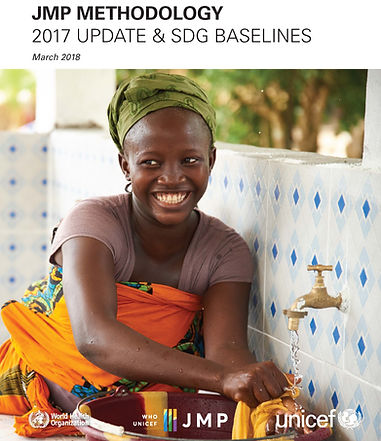
JMP METHODOLOGY
2017 UPDATE & SDG BASELINES
.jpg)
The WHO/UNICEF Joint Monitoring Programme for Water Supply, Sanitation and Hygiene (JMP) was established in 1990 and has continuously refined the methods used for global monitoring. This document describes the methods and rules applied in the last JMP report, “Progress on drinking water, sanitation and hygiene: 2017 update and SDG baselines”.
Pollution affects even oceanic marine protected areas in Southwestern Atlantic

Reefs are facing a global decline with sewage pollution emerging as a significant and poorly understood threat. Inadequate wastewater management and disorderly urbanization contribute to water pollution globally. Tropical Southwestern Atlantic comprises a set of oceanic Marine Protected Areas (MPAs) including the Fernando de Noronha Archipelago in Brazil, which has experienced significant population growth without expanding the sewage infrastructure.
Global, regional, and country level need for data on wastewater generation, treatment, and use

Irrigation with wastewater supports agricultural production and the livelihoods of millions of smallholder farmers in many parts of the world. Considering the importance of better wastewater management at the local and national levels, there is a need for updated national data on wastewater generation, treatment, and use, which would also assist in regional and global wastewater assessments. While searching data and literature in published or electronic forms for 181 countries, we find that only 55 countries have data available on all three aspects of wastewater – generation, treatment, and use.
A global indicator of wastewater treatment to inform the Sustainable Development Goals
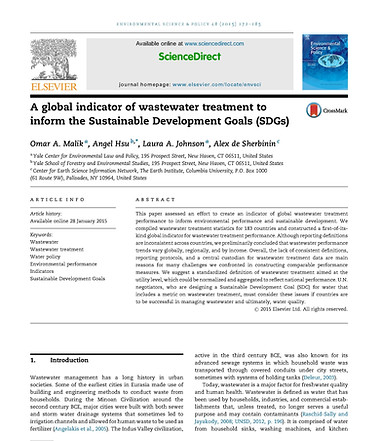
This paper assessed an effort to create an indicator of global wastewater treatment performance to inform environmental performance and sustainable development. We compiled wastewater treatment statistics for 183 countries and constructed a first-of-itskind global indicator for wastewater treatment performance. Although reporting definitions are inconsistent across countries, we preliminarily concluded that wastewater performance trends vary globally, regionally, and by income. Overall, the lack of consistent definitions, reporting protocols, and a central custodian for wastewater treatment data are main reasons for many challenges we confronted in constructing comparable performance measures.
A review on the sustainability of constructed wetlands for wastewater treatment: Design and operation

Constructed wetlands (CWs) have been used as a green technology to treat various wastewaters for several decades. CWs offer a land-intensive, low-energy, and less-operational-requirements alternative to conventional treatment systems, especially for small communities and remote locations. However, the sustainable operation and successful application of these systems remains a challenge.
The potential of wastewater treatment on carbon storage through ocean alkalinity enhancement
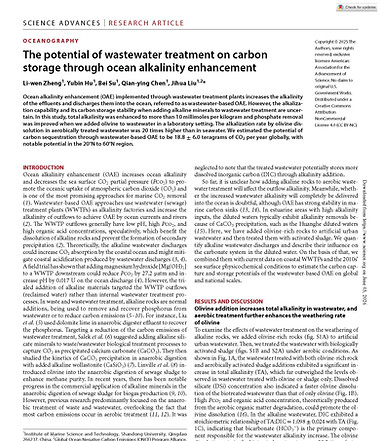
Ocean alkalinity enhancement (OAE) implemented through wastewater treatment plants increases the alkalinity of the effluents and discharges them into the ocean, referred to as wastewater-based OAE. However, the alkalization capability and its carbon storage stability when adding alkaline minerals to wastewater treatment are uncertain.
Debt swaps could release $100 billion for climate action

More than US$100 billion of debt in developing countries could be freed up to spend on restoring nature and adapting to climate change, according to new analysis by IIED.
‘Debt for climate and nature swaps’ are an important but underused tool for addressing three major problems facing less-wealthy nations: crippling debt, the impacts of climate change, and biodiversity loss.
If a country and its creditors agree to a swap, a portion of that nation’s debt can be written off in exchange for achieving specific, measurable and traceable outcomes in climate or nature projects.
Poorest countries spending billions more servicing debts than they receive to tackle climate change

The world’s most climate-vulnerable countries are being forced to spend billions more paying off their debts than they are receiving in help to beat climate change, according to new analysis by IIED. In 2021 – the most recent year of data available – the cost of debt repayment for 59 nations was US$33 billion compared to just $20 billion they received in climate finance. Nine of these countries paid out more than they received in total from foreign aid.